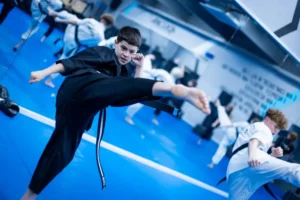
Most people think discipline is a personality trait. Fighters learn it is a skill.
You do not wake up one day with perfect willpower. You build it the same way you build a clean jab, a strong base, or a smooth guard pass: repetition, feedback, and a standard you refuse to abandon. That is the core of a strong martial arts mindset.
Martial arts is one of the rare places where your mind cannot hide. If you drift mentally, you get tagged. If your ego takes over, you make reckless choices. If you panic, you burn energy and lose clarity. Training turns discipline from a nice idea into something measurable.
This guide breaks down how training builds discipline and focus, how it sharpens emotional control training under pressure, and how you can keep progressing even when martial arts motivation fades.
Why discipline is easier to build on the mat than in normal life
In everyday life, consequences often arrive late. You can procrastinate and still recover. You can skip routines and feel fine for a while. Your mind learns to negotiate.
On the mat, feedback is immediate. Bad posture gets exposed. Poor breathing shows up in your gas tank. A wandering mind gets punished by simple, basic technique. That is why mental toughness in martial arts is so reliable: the environment trains honesty.
Over time, you stop relying on hype. You rely on routine. Two or three consistent sessions a week will reshape your identity faster than any burst of intensity.
What a real martial arts mindset looks like
A healthy martial arts mindset is not aggression. It is control.
At its best, it has three qualities:
Commitment to the process
You stop hunting quick results and start collecting reps. You accept that mastery is sometimes boring, and that boredom is part of the price.
Respect for fundamentals
Under pressure, you do not reach for fancy solutions. You return to stance, posture, breathing, timing, and positioning.
Calm under consequence
You learn to stay functional when your heart rate is high. You reset after mistakes instead of spiraling.
This is discipline in motion, not discipline in theory.
How martial arts trains focus in a way normal workouts cannot
You can lift weights while thinking about something else. You cannot spar that way.
Martial arts forces attention because the moment demands it. You read movement. You manage distance. You track timing. You listen to coaching while your body is tired. That is discipline and focus being trained in real time.
The one-theme rule
To improve faster and stay mentally sharp, choose one focus theme per session:
- Protect my base and posture.
- Breathe through exchanges.
- Stay relaxed after mistakes.
One theme keeps your mind from scattering. It also makes your improvement visible, which is fuel for long term discipline.
Emotional control is the fighter’s hidden advantage
Most people assume fighters are fearless. In reality, everyone feels pressure. The difference is what you do with it.
emotional control training means you can feel anger, fear, or frustration without letting it drive your decisions. You stay strategic. You stay patient. You stay readable to yourself and unpredictable to your opponent.
A simple reset you can practice every round
When you feel your emotions spike, do this:
- Notice the spike without judging it.
- Exhale slowly once, longer than your inhale.
- Return to your one theme.
That single reset builds calm under stress. With time, it becomes automatic.
When motivation fades, systems keep you training
If your plan depends on feeling inspired, it will collapse the first week life gets busy. That is why martial arts motivation should never be your foundation.
Use simple systems that survive real life:
Two anchors per week
Pick two training days and protect them like appointments. When your schedule is chaotic, those anchors keep you in the game.
Minimum session rule
On low-energy days, do the smallest useful session that keeps the habit alive. A light class or 20 minutes of basics is not a failure. It is maintenance.
Remove friction
Pack your gear the night before. Decide your class time in advance. Discipline often starts by making the right choice easier than the comfortable choice.
This is how a strong martial arts mindset gets built without relying on speeches.
The discipline loop every martial artist lives by
Discipline becomes real when you repeat a simple loop:
Show up
Even if you feel average. Especially if you feel average.
Train with standards
Clean reps. Honest effort. Respect for fundamentals. No ego battles.
Reflect briefly
Two minutes is enough: what worked under fatigue, where did my mind drift, what is my one focus next time?
Repeat until it becomes identity
Eventually, discipline stops feeling like effort and starts feeling like normal. That is the point where mental toughness in martial arts becomes part of who you are, not just what you do.
Taking the warrior mindset off the mat
The best part of martial arts discipline is that it transfers.
When you train consistently, you get better at starting tasks without waiting for the perfect mood. You become less reactive in conversations. You learn that progress comes from routine, not from intensity.
Mental toughness without becoming harsh
There is a difference between discipline and self-punishment. Some people try to build toughness by attacking themselves: guilt after missed sessions, training through pain they should respect, or comparing themselves constantly. That approach looks intense, but it is fragile.
Healthy mental toughness in martial arts is firm and sustainable. It is being honest about your effort while still protecting the long game. When you miss a session, you do not spiral. You adjust the system. When you have a bad round, you do not call it failure. You treat it as data.
A simple rule helps: be strict with your standards, but patient with your timeline. That mindset keeps you training for years, not weeks.
Final thought: discipline is built, not found
If you want to change your mindset, you need a practice that demands consistency. Martial arts is that practice.
Build your martial arts mindset like you build technique: one rep at a time, with patience, attention, and standards you can keep. Over months, your focus sharpens. Your emotions calm. Your decisions improve. And the discipline you wanted becomes something you live, not something you chase.