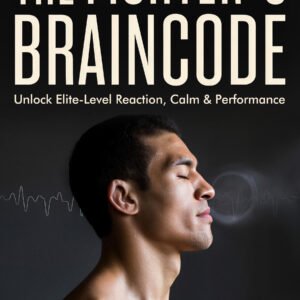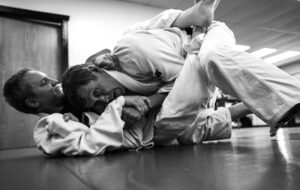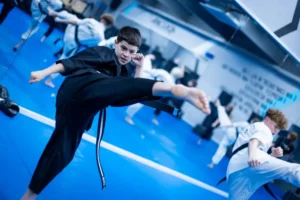
Many martial artists train their bodies relentlessly while neglecting the most powerful tool they have: the mind. Strength, speed, and technique are essential, but without mental clarity they fall apart under pressure. This is why meditation for martial artists has always existed, even if it was not always called meditation.
From ancient warriors to modern fighters, stillness has been used to sharpen awareness, regulate emotion, and sustain focus. Meditation is not about becoming passive or calm all the time. It is about learning control. In martial arts, control is performance.
This article explains how meditation supports training, how it improves focus and emotional balance, and how martial artists can use it practically without changing their identity or routine.
Why martial arts and meditation belong together
Martial arts demands presence. If your mind drifts, your timing fails. If your emotions spike, your decisions suffer. Meditation trains the exact mental qualities martial artists need.
Mental clarity martial arts training is about seeing clearly under stress. Meditation strengthens this by teaching you how to observe thoughts instead of being pulled by them. You learn to stay centered while the body is working hard.
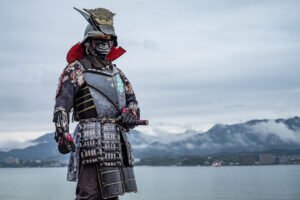
Historically, many fighting systems included meditative practices. Samurai used seated stillness. Monks used breath awareness. These practices were never separate from combat. They supported it.
Meditation is not weakness, it is control
Some fighters resist meditation because they associate it with softness. In reality, meditation builds inner structure. It sharpens awareness and reduces wasted energy.
A tense fighter reacts late. A calm fighter sees early. Meditation teaches the nervous system how to stay relaxed while alert. That balance defines high level performance.
This same principle is explored in The Art of Stillness: Finding Balance Between Aggression and Calm in Martial Arts, where calm becomes a weapon rather than a retreat.
How meditation improves focus in training
Focus is not effort. It is clarity.
Meditation strengthens your ability to place attention where you choose. In training, this means tracking distance, timing, and breath simultaneously without mental overload.
Mindfulness training in combat allows you to notice subtle shifts in your opponent and in yourself. You stop forcing outcomes and start responding intelligently.
With regular practice, your mind becomes quieter during movement. Technique flows instead of feeling forced.
Emotional control under pressure
Every martial artist knows the feeling of emotional spikes. Frustration after mistakes. Anxiety before sparring. Anger during tough rounds.
Meditation trains you to observe these emotions without reacting impulsively. This builds stress control in live situations.
When emotions no longer dictate behavior, you make better choices. You conserve energy. You recover faster after setbacks.
Breathing as the bridge between mind and body
Breath is the fastest way to influence the nervous system. Meditation teaches conscious breathing, which directly impacts performance.
Breathing techniques improve:
- Endurance during long rounds
- Recovery between exchanges
- Emotional stability under pressure
Controlled breathing keeps heart rate manageable and attention steady. This allows technique to remain precise even during fatigue.
In many martial arts traditions, breath control was considered as important as physical strength.
Meditation for beginners in martial arts
Beginners often struggle with information overload. Too many techniques. Too many corrections. Too much self judgment.
Meditation simplifies learning. It teaches beginners to focus on one thing at a time. Breath. Balance. Posture.
This supports mental clarity martial arts training early and prevents frustration.
Simple meditation practices for martial artists
Meditation does not require long sessions or special settings. Short, consistent practice works best.
Pre training stillness
Sit quietly for two minutes before class. Focus on breathing through the nose. This prepares the mind for learning.
Post training reflection
After class, sit for three minutes. Observe breath and body sensations. This helps the nervous system recover and reinforces learning.
Breath focus during rounds
Between rounds, take one slow breath longer than usual. This resets emotional balance quickly.
These practices integrate seamlessly into training.

Meditation sharpens decision making
Fighting requires rapid decisions. Meditation improves decision quality by reducing mental noise.
When the mind is calm, choices become simpler. You stop overthinking. You trust fundamentals.
This clarity supports meditation for martial artists by aligning intention with action.
Reducing burnout and overtraining
Burnout often begins mentally before it appears physically. Meditation helps identify early signs of exhaustion and frustration.
By developing awareness, you recognize when to push and when to recover. This balance protects long term progress.
Martial artists who meditate tend to train longer and more consistently because they manage stress intelligently.
Carrying meditative awareness into daily life
The benefits of meditation extend beyond training. Improved focus, patience, and emotional balance affect work and relationships.
Martial artists often notice they react less impulsively and handle stress more effectively. This transfer is natural because the same nervous system is involved.
Common misconceptions about meditation in martial arts
Meditation is not about emptying the mind. Thoughts will arise. The practice is noticing without attachment.
It is not about being calm all the time. It is about being in control.
It is not separate from training. It enhances training.
Understanding this removes resistance and allows meditation to become practical rather than abstract.
Consistency matters more than duration
Short daily practice beats occasional long sessions. Two to five minutes a day is enough to see change.
Consistency builds familiarity. Familiarity builds control.
Over time, meditation becomes as natural as warming up or stretching.
Final thought: stillness creates power
True power in martial arts comes from clarity, not chaos.
Meditation for martial artists trains the mind to stay centered while the body moves with intensity. It improves focus, emotional control, and resilience.
When you combine physical training with mental stillness, performance stabilizes. Technique sharpens. Pressure loses its grip.
Stillness is not the opposite of strength. It is the source of it.